Why Your Brain Can Learn to Sleep Better
Ever noticed how a familiar sound—like rain on the roof—can make you feel instantly drowsy? That's not just comfort. It's your brain using a learning mechanism called classical conditioning that you can harness to fall asleep faster every night.
The Simple Science
When you pair the same calming sounds with sleep, night after night, your brain learns to connect them. After a few weeks, just hearing those sounds triggers your body to start winding down—lowering your heart rate and preparing for rest [1].
What's fascinating is that this learning continues while you sleep. Research shows we can form new associations during sleep itself, which means each night strengthens the connection between your chosen sounds and deep rest [2].
How to Make It Work
Studies show a clear pattern: the more consistent your bedtime routine, the faster you fall asleep [3]. Here's how to build an effective sleep sound ritual:
Be consistent — Use the same sounds every night. Your brain needs repetition to build strong associations.
Start early — Begin playing your sounds 15-20 minutes before you want to sleep.
Keep them playing — Let the sounds continue through the night to reinforce the connection.
Choose wisely — Pick gentle, steady sounds like rain, ocean waves, or forest ambience. Avoid anything with sudden changes.
What If I Stop Noticing the Sounds?
Over time, you may stop consciously noticing your sleep sounds—and that's actually a good sign. It means your brain has learned the association so well that the sounds fade into the background while still triggering your sleep response.
If you feel the need for variety, try creating 2-3 similar soundscapes with subtle differences rather than switching to completely new sounds. This keeps things fresh without disrupting the conditioning you've built.
Why Sonora Works for This
Sonora is built for exactly this kind of sleep conditioning:
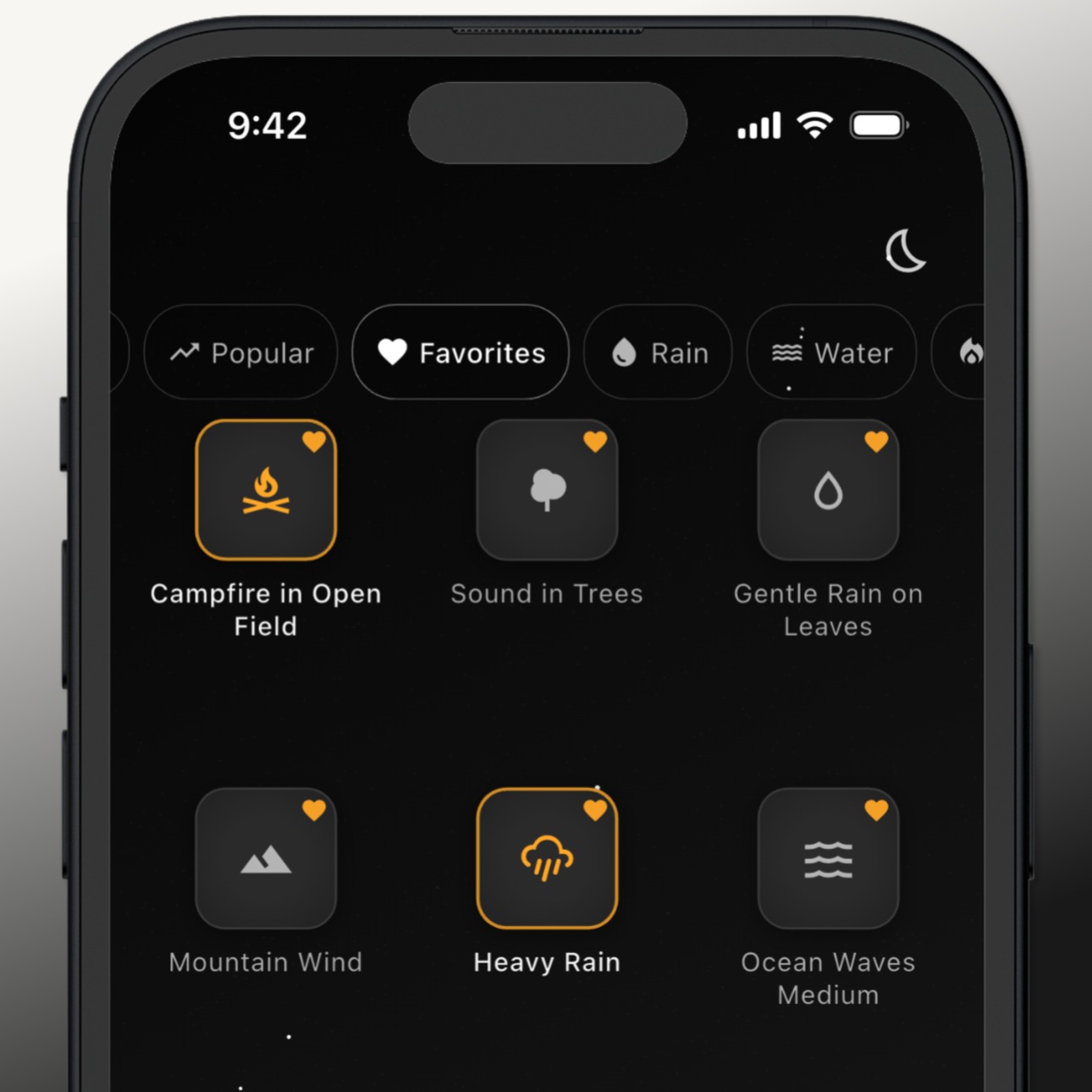
- Create your perfect mix — Combine rainfall, waves, crackling fire, and more. Your brain learns your specific combination.
- Fine-tune every detail — Adjust individual volume levels to create a soundscape that's uniquely yours.
- Save multiple mixes — Keep 2-3 variations for subtle variety while maintaining consistency.
- Same every night — Sonora saves your exact settings, so you get identical conditions each time.
The best part? After 2-3 weeks of consistency, you'll likely notice you're falling asleep faster—and it only gets stronger over time.
References
[1] Pavlov, I. P. (1927). Conditioned Reflexes: An Investigation of the Physiological Activity of the Cerebral Cortex. Oxford University Press.
Full Text - Archive.org
[2] Arzi, A., et al. (2012). Humans can learn new information during sleep. Nature Neuroscience, 15(10), 1460-1465.
DOI | PubMed
[3] Mindell, J. A., et al. (2015). Bedtime routines for young children: a dose-dependent association with sleep outcomes. Sleep, 38(5), 717-722.
PMC Free Access